 Reel Motion Pros
Book a call
Reel Motion Pros
Book a call
The Media Department for Companies That Don't Have One.
Most companies buy video like they buy plumbing. Something breaks, they call somebody, they pay, it ends. Six months later they need another one and start over with a vendor who doesn't know their brand, their people, or where the last footage lives. That is not how a department works.
You shot a conference last year. Where is it? Somebody has a hard drive. Maybe.
Video happens when somebody panics about a launch. Never when there's time to do it right.
Your marketing lead is not a producer. Your vendor is not in the meeting. So the work has no direction, just deadlines.
Every product below exists to fix one of those.
I Have an Event Coming
Summits, user conferences, trade shows. Capture, or capture plus daily delivery.
Capture Suite · Show Floor to Feed →I Need My Customers on Camera
Proof from the field, and a quarter of executive content in a day.
Proof Tour · The Content Quarter →I Need This to Be Somebody's Job
A department on retainer, or a studio built in your building.
Retainer · Studio Build →A Media Suite That Runs Your Whole Event.
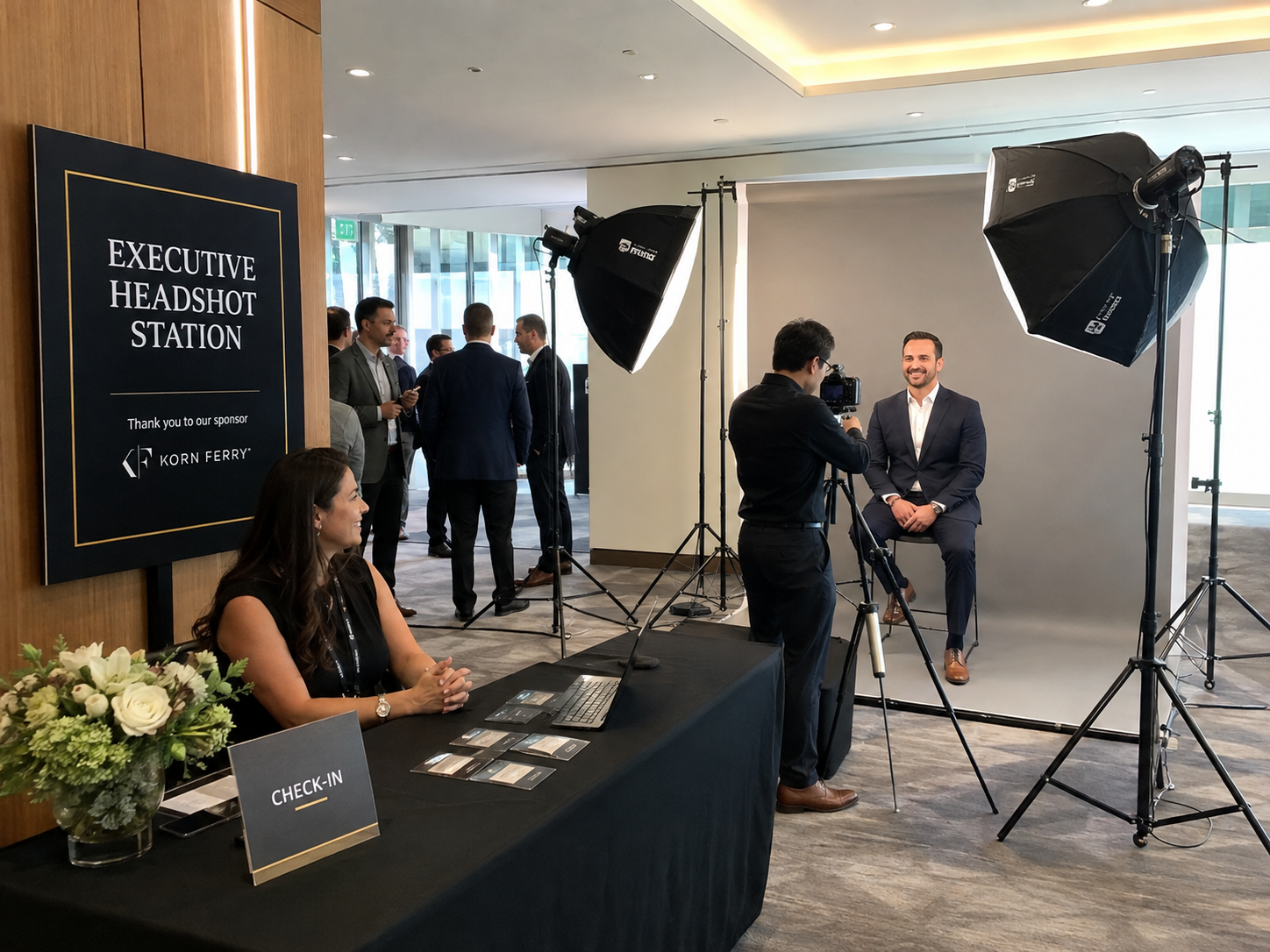
Not a photo booth in the corner. Three setups running at the same time: a headshot studio for your guests, a small room for filming customer stories, and a quiet corner where speakers record short quotes. One space, one crew, one photo gallery with your branding, and everything handed over before people fly home.
The national headshot companies fly in, take photographs, and leave. You get photos. You do not get anything you can post. We shoot photo and video in the same setup, with the same crew, and you leave with a labeled library you can use all year.
Here is the part most organizers miss: you may not have to pay for this at all. A sponsor pays for the studio, gets their logo on the gallery, the sign-up form and every delivery email, and walks away with a list of everyone who sat in the chair and agreed to be contacted. Your guests get something they actually want, and it costs you nothing. We will help you put together the pitch that sells it to a sponsor.
Your happiest customers are the hardest people to get on camera. Not because they would say no, but because getting a crew, a room and a busy person into the same place never reaches the top of anyone's list.
So we stop trying to schedule it. Your customers already flew in for your event. Asking for eighteen minutes of a day they have already given you is a small ask. Asking the same person cold, by email, in March, is a big one, which is why most customer story projects quietly die in the calendar.
Permission forms are signed at the door with the badge scan, so nothing sits in legal review for six weeks. You leave the conference with twelve to twenty finished stories instead of a promise to follow up.
of each customer's day 12 to 20
stories in two days 4 versions
cut from every story
Booked one at a time, a single customer story runs $3,000 to $8,000 in this market. Filmed together, in a room your customers walk into between sessions, the same fifteen stories work out closer to $900 each.
- A headshot studio for your guests, edited and sent the same day
- A small room for filming customer stories, with a producer asking the questions
- A quiet room where speakers record short quotes between sessions
- A photo gallery with your branding, a QR code to sign up, and permission forms collected at the door
- A list of everyone who took part, sent to your sponsor afterwards
Your Customers Don't Sound Like Your Customers on Zoom.
Everybody selling B2B testimonials right now is remote-first. It scales for them. It does not work for you, because your best customer is a plant manager in Odessa, a hospital COO in Fort Worth, a fleet director outside Waco. Put that person on a webcam and you get someone talking at a laptop in a beige room. Put a camera in their facility and you get proof.
You hand us five customers. We plan the route, drive it, and shoot on site: the interview, the facility, the product actually in use, the handshake. Three to five stories in three days.
Then you get a set of files for each customer, not one long video nobody finishes. One main video, three vertical clips for phones, five quote graphics, and photographs.
- Route planning and customer scheduling, we handle the coordination
- On-site interview with a producer, not a camera pointed at a chair
- Extra footage of their building and your product in use, while we are there
- A set of files for each customer, ready for sales, social media and your website
- We handle the permission forms and the sign-off
One Day In. Ninety Days Out.
Your executives will give you one day. They will not give you six afternoons spread across a quarter. So we take the one day and build the entire quarter out of it.
The map comes first. Before anybody stands in front of a light, we sit with your marketing calendar and work out exactly what the next ninety days need. Then we shoot against that list: wardrobe changes, backdrop resets, structured blocks. Straight-to-camera pieces in the morning, podcast after lunch, short social clips all afternoon.
You leave with twelve to fifteen clips, two longer videos, and photographs. And a map for next quarter, because the point is that this happens again in ninety days, not that it happens once.
- Content map built against your marketing calendar
- Full studio day, on site or in a stage
- Teleprompter and on-camera coaching for the reluctant ones
- Podcast or relaxed on-camera conversations recorded in a batch, at the Executive tier
- Everything captioned, sized, and named for where it's going
Your Booth Cost Eighty Grand. Your Recap Arrives in Three Weeks.
By then the show is over, the leads have gone cold, and the footage is a nice keepsake for the folder nobody opens.
We edit on site. Day one gets cut overnight, and your day two feed is running day one footage while the show is still happening. Speaker clips at lunch. The full recap before the crew packs up. Your sales team is sharing content from a conference they are currently standing in.
This is not the standard event coverage package with a rush fee stapled on. It is a different crew structure, with an editor who is there for the nights.
- Several cameras covering the floor and the talks
- Overnight edit, on site
- A highlight video by the end of the first night
- Speaker and session cuts by midday two
- The full recap video before the crew packs up
- Everything sized for LinkedIn, stage screens, and post-show email
We'll Build Your Studio. Then We'll Run the Part You Can't.
Sounds like we're talking ourselves out of work. We're not.
Every company that builds an internal studio figures out inside ninety days that they can shoot but they cannot direct. The room works. The lighting works. What's missing is somebody who knows which story to tell and how to cut it. That is the job we want.
So we spec the room, buy the gear, set the workflow, build the templates, and spend two days training your team on the easy stuff. Then we stay on call for everything above that ceiling.
- We assess the room and work out the sound treatment and lighting it needs
- We buy the equipment and set it all up
- A filing system, naming rules, and somewhere safe to keep everything
- Branded templates: name captions, intros, and caption styles
- Two days of hands-on training for your team
- Studio on call, monthly
Hire the Department.
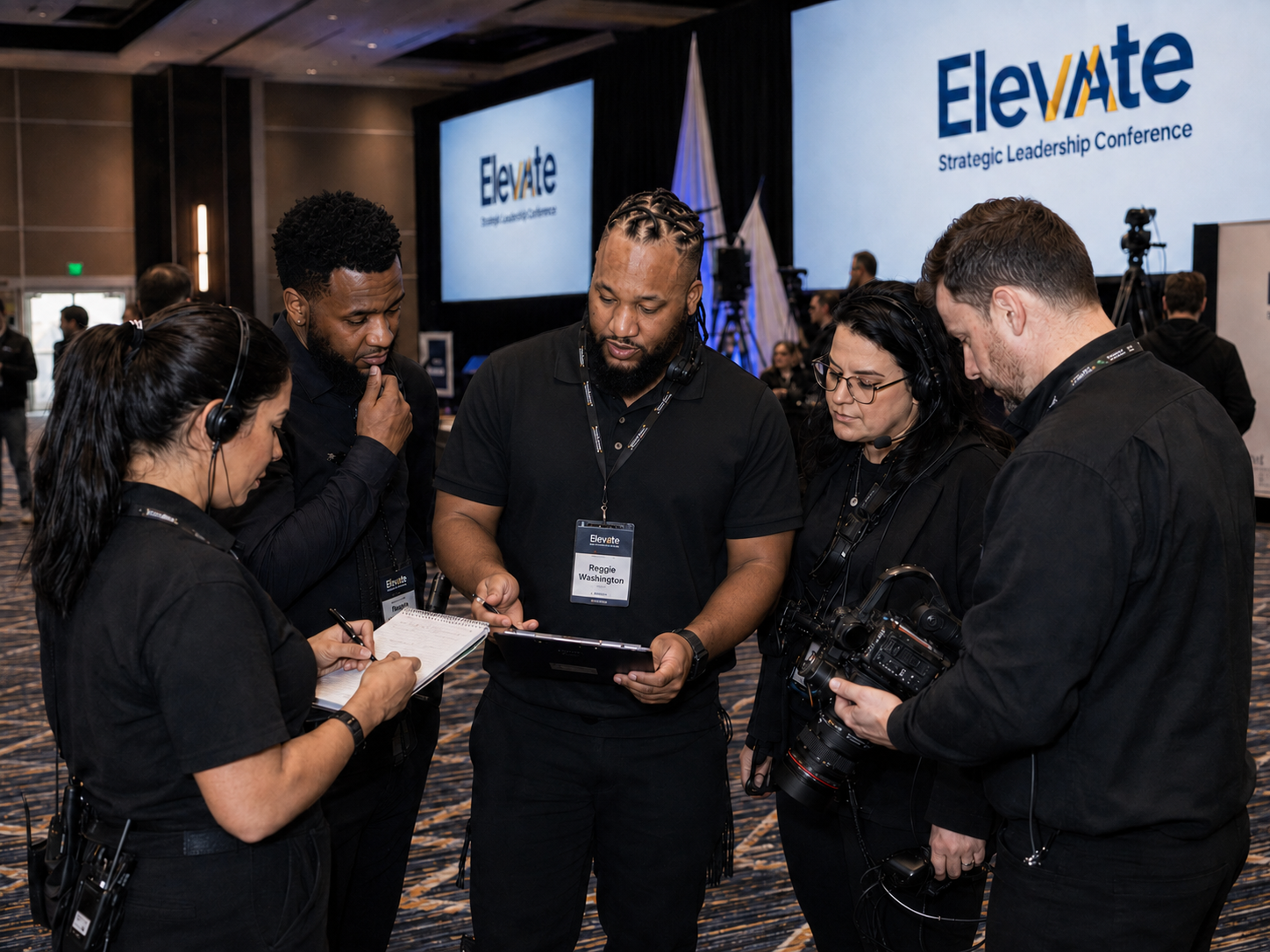
A fractional creative director costs ten to fifteen thousand a month and then you still have to hire somebody to shoot. We do both. We're in the planning meeting, we own the calendar, we manage the archive, and we're the ones holding the camera.
A department has a cadence. It has standards. It knows which exec hates being on camera and which customer will always say yes. That institutional memory is the actual product. The videos are just what it produces.
Thirty minutes. What you're shipping this year, what's stuck, what you've already got sitting on a drive.
We come back with a plan and a number. Not a proposal deck. A plan.
We show up early, we're easy to have around, and we're gone before anybody gets tired of us.
Named, sized, captioned, and filed where your team can actually find it. Every time.
Questions People Actually Ask.
What does this actually cost?+
Programs start at $2,500 and retainers start at $3,500 a month. Most of what we do lands between eight and twenty thousand per engagement. If you need a single video and nothing else, we're probably not your best call, and we'll tell you that on the phone instead of after the invoice.
We already have a video guy.+
Good. Keep him. Half our retainer work is directing people who already have a shooter and no plan. We can run the calendar and hand him the shot list.
Can you just do one video?+
Yes. It's just the most expensive way to buy video, because the setup costs the same whether we capture one story or five. If you're going to need three this year, book them as one day and pay a lot less per piece.
How fast?+
Standard delivery is two weeks. Content Quarter is ten days. Show Floor to Feed is overnight, every night. Capture Suite is same day, on site.
Do you travel?+
Constantly. Based in Fort Worth, most work is DFW and Texas, and we go wherever the customers are. Travel is billed at cost and itemized.
Who actually shows up?+
Reggie, on every project. Crew scales with the job. You will not get sold by one person and delivered by somebody you've never met.
Let's Find Out What You Already Have.
Half of the first call is usually us telling you there's a year of usable footage sitting on a drive somebody forgot about. That part's free.
Book a call